
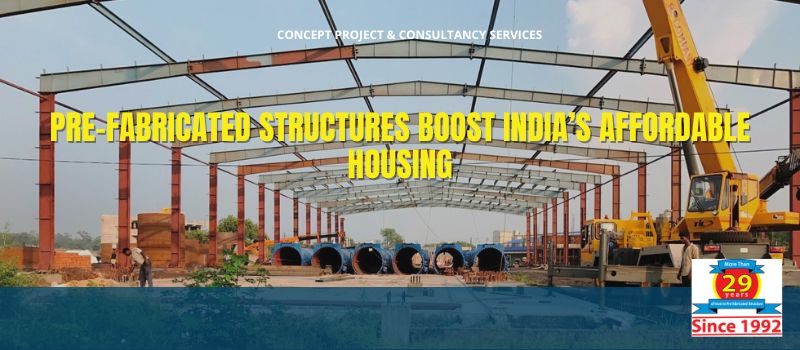
India faces a pressing challenge: providing affordable housing to millions while maintaining quality and speed. Traditional construction methods often fall short due to high costs, labour shortages, and lengthy timelines.
Pre-fabricated structures in India have emerged as a practical, cost-effective solution for developers and government projects alike. They combine efficiency with durability, helping businesses and communities alike meet growing housing demands.
For construction companies and real estate developers, pre-fabrication offers more than speed. It ensures consistent quality, reduces on-site disruptions, and allows scalable solutions.
As India pushes towards ambitious housing targets, modular construction becomes an essential strategy for achieving sustainable and affordable living spaces.
What Are Pre-Fabricated Structures and Why Are They Popular?
Pre-fabricated structures, also called modular or factory-built structures, consist of components manufactured off-site and assembled quickly on location. They have gained popularity in India for several reasons:
- Shorter construction timelines, reducing project completion by up to 50%.
- Lower material wastage, making construction eco-friendly.
- Controlled factory environment ensures consistent quality.
- Minimal dependence on skilled labour at the site.
These benefits make pre-fabricated structures ideal for developers aiming to balance cost, speed, and quality.
How Do Pre-Fabricated Structures Address India’s Affordable Housing Needs?
Affordable housing projects face challenges such as rising land costs, high labour expenses, and material shortages. Pre-fabricated solutions tackle these efficiently. Developers can complete projects faster and more economically, which allows homes to be priced reasonably.
According to a 2025 industry report, modular construction can cut overall project costs by 20–30% while reducing construction timelines by nearly half. This makes pre-fabrication a viable tool to help meet India’s goal of providing housing for all.
Which Projects and Industries Benefit Most from Pre-Fabrication?
Several sectors and projects can leverage pre-fabrication effectively:
- Government housing schemes like PMAY.
- Private residential developments targeting affordable and mid-range buyers.
- Industrial and corporate housing.
- Temporary structures for disaster relief or emergency housing.
Businesses adopting pre-fabricated structures can scale quickly, reduce costs, and maintain quality control.
What Are Key Considerations for Successful Implementation?
While pre-fabrication offers clear advantages, developers should plan carefully:
- Choose the right materials for durability and climate adaptability.
- Ensure skilled workforce for on-site assembly.
- Coordinate logistics for transportation and assembly of modules.
- Comply with local building regulations and safety standards.
Projects that consider these factors can achieve faster completion with fewer errors and reduced operational costs.
How Can Businesses Leverage Pre-Fabricated Structures for Growth?
Integrating pre-fabricated structures in India allows developers to:
- Deliver affordable housing faster.
- Reduce operational and labour costs.
- Gain a competitive edge in government tenders and private projects.
Companies embracing modular solutions can meet market demand efficiently while maintaining high-quality construction standards.
Pre-fabricated structures offer a smart, cost-effective route to meeting India’s affordable housing targets. They ensure speed, quality, and scalability, making them essential for construction businesses. Developers and contractors can rely on innovative solutions to deliver homes efficiently.
For businesses looking to implement modular construction, Concept Project provides expert services in pre-fabricated structures in India, combining quality, efficiency, and sustainable building practices. Partner with us to meet your affordable housing goals with confidence. Contact us now.